 For most theologians, scholars, preachers, pastors, and
laity that the food laws no longer apply to us is taken as a ‘simple and
obvious’ fact. This is not too dissimilar to how much of society considers it a
simple and obvious fact that dinosaurs never lived with humans. Because of
years of being told that dinosaurs lived millions of years before humans
through books, films, and education, the idea of creationism is mocked as
nonsense. That Genesis describes humans and all animals (which would include
dinosaurs) being created on the same day is ridiculous and obviously wrong.
Similarly, when you might suggest that perhaps the food laws weren’t done away
with, because of centuries of an inherited doctrine that the law was done away
with, you’re obviously wrong. And just as the atheist will interpret the
evidence through the lens of naturalism to defend their position that dinosaurs
never lived with humans, most Christians will read Scripture through the lens
of the inherited idea that the Law is bad and just for the Jews, despite the
Bible saying otherwise, and as we have seen in our previous posts, read things
into the text that aren’t even there. Commentator William J. Larkin Jr. brings the
arguments that this post series have covered together quite succinctly in his
discussion of Peter’s vision in Acts 10,
For most theologians, scholars, preachers, pastors, and
laity that the food laws no longer apply to us is taken as a ‘simple and
obvious’ fact. This is not too dissimilar to how much of society considers it a
simple and obvious fact that dinosaurs never lived with humans. Because of
years of being told that dinosaurs lived millions of years before humans
through books, films, and education, the idea of creationism is mocked as
nonsense. That Genesis describes humans and all animals (which would include
dinosaurs) being created on the same day is ridiculous and obviously wrong.
Similarly, when you might suggest that perhaps the food laws weren’t done away
with, because of centuries of an inherited doctrine that the law was done away
with, you’re obviously wrong. And just as the atheist will interpret the
evidence through the lens of naturalism to defend their position that dinosaurs
never lived with humans, most Christians will read Scripture through the lens
of the inherited idea that the Law is bad and just for the Jews, despite the
Bible saying otherwise, and as we have seen in our previous posts, read things
into the text that aren’t even there. Commentator William J. Larkin Jr. brings the
arguments that this post series have covered together quite succinctly in his
discussion of Peter’s vision in Acts 10,The voice comes again, this time providing the rationale: God has declared all foods clean. Peter is not to go on declaring some foods profane or "common." Jesus' teaching and behavior had certainly prepared the way for such a declaration (Mk 7:14-23; Lk 11:39-41), and the cross was the salvific basis for it (Eph 2:14-15; Col 2:14). The sheet from heaven and the voice both bear witness that all God's creatures are now to be viewed as clean and good, not to be refused (Gen 1:31; 1 Tim 4:3).
But as we have seen, Jesus did not bring an end to the
supposed ‘ceremonial’ law (here), nor did he declare all foods clean to the
Pharisees and the disciples, (here) nor specifically to Peter in Acts 10 via
the Holy Spirit (here). In the latter two, the dispute was about the man-made
purity category of common, which is distinct from unclean. A fact that is
ignored (intentionally or not) when interpreting these passages.
To conclude this series on the food laws, we will
continue looking at the apostolic period, this time considering Paul’s words on
the matter. One of Paul’s key teachings on the matter is found in Romans 14,
where Paul is dealing with disputes between ‘the weak’ and ‘the strong’ in
regards to food. In verse 14, Paul states:
I know and am persuaded in the Lord Jesus that nothing is unclean in itself, but it is unclean for anyone who thinks it unclean.
So, there you have it. Nothing is unclean except for
those who think it is. Food laws are now a matter of conscience, right? Would
you be surprised (probably not) to learn that that is not what the Greek says.
Let’s revisit an old friend to see what Paul really said:
I know and am persuaded in the Lord Jesus that nothing is common (koinen) in itself, but it is common for anyone who thinks it common.
Therefore, what Romans 14:14 should really say is, food is
not polluted by coming into contact with something unclean. In Acts 10, Peter
was talking about Gentiles being common. Here, like Jesus, Paul is talking
about food becoming common. What is interesting is that prior to 1611,
virtually every English translation such as the Coverdale and Tyndale version all
say ‘common.’ Even Luther’s translation of 1545 uses common (gemein) instead of
unclean (unreines). But for some reason, since the publication of the KJV, we
begin to see unclean being used instead of common. Could it be because older,
more reliable manuscripts use ‘unclean’ instead? No. The oldest complete
manuscript, Codex Sinaticus from the 4th century uses common
(koinen) instead of unclean (akathartos), which agrees with many other later
manuscripts such as the Textus Receptus and the Stephanus New Testament. The
fact that translators can use common in Acts 10, but not in Romans 14 makes the process quite questionable. Perhaps they were ignorant of the fact that, as
we see in Peter’s declaration, that common and unclean are actually different.
As Colin House explains, “Even though Peter consistently differentiated between
‘common’ and ‘unclean,’ it seems reasonable to assume that the various
translators of the English Scriptures believed this distinction to be defunct.”
Or perhaps it was more convenient to create a proof-text out of Romans 14:14 to
reinforce either their freedom to eat whatever they want, or maintain a differentiation
between us Christians, and those Jews. Either way, the translators knowingly
mistranslated a word which is misleading to its readers. Therefore, Paul’s
argument is all about the category of common, and not the abolishment of the
food laws of Leviticus. And this is how we should define the ‘weak’ follower of
Christ in Romans 14:2-3 about whom Paul writes:
One person believes he may eat anything, while the weak person eats only vegetables. Let not the one who eats despise the one who abstains, and let not the one who abstains pass judgment on the one who eats, for God has welcomed him.
The weak here are often assumed to be legalists. Those
who have not yet grasped the concept of justification by grace, and that the
food laws are done away with. For example, Calvin describes the weak as those
who could not let go of the law, and “they would have thought otherwise, had
they possessed a certain and a clear knowledge of Christian liberty." Similarly, Douglas Moo describes the weak as those who are unable to “accept…
the truth that their faith in Christ implies liberation from certain OT/Jewish
ritual requirements." And this is interesting because the Apostles at
Jerusalem council in Acts 15 promoted the law's 'ritual requirements' of abstaining from
blood etc…, and Paul underwent a Nazarite Vow in Acts 20. Therefore, according to Douglas Moo’s definition, the Apostles were weak Christians.
The Augsburg Confession suggests that “they forbade it for a time, to avoid
offense” (28.65), however that is assumed since Scripture makes no mention of
that. But notice in verse 2 Paul
provides the explanation of those who are weak: the ones who "eat only
vegetables." This means that the weak are those abstaining from all meats, not merely
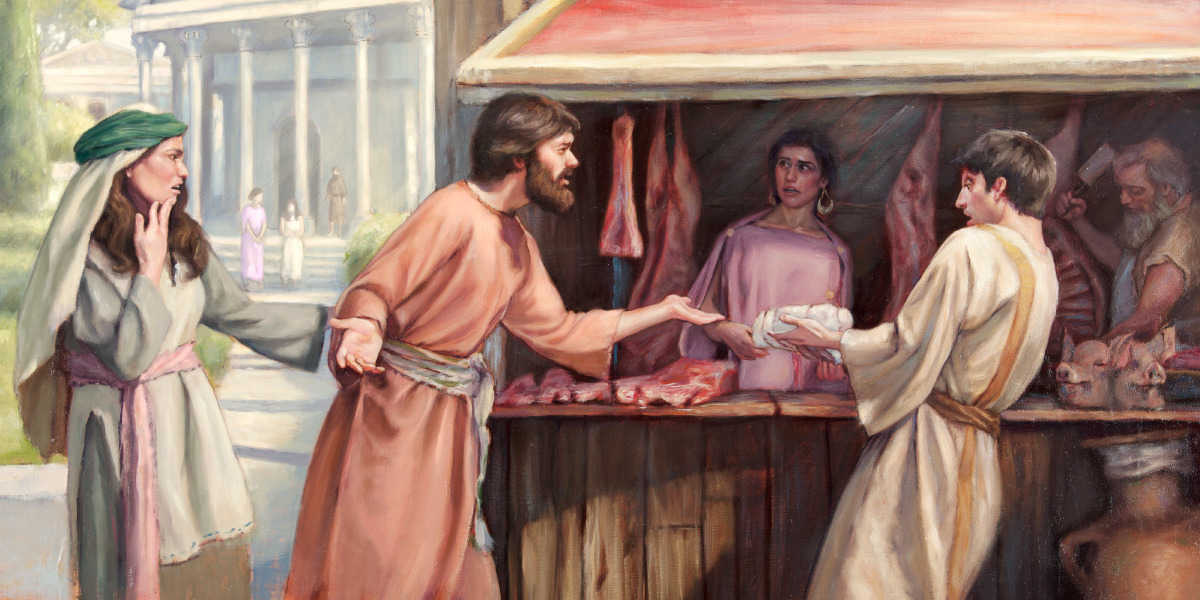
unclean meats. Moo suggests that the reason they do is because they cannot
guarantee the kosher quality of meat in the marketplace, however,
considering the discussion about common in verse 14, it is more than likely
that the weak are those avoiding food sacrificed to idols from the marketplace
since they believed this was a significant source of food pollution.
Consider Paul’s similar wording in 1Cor 8:7, "…not all possess this knowledge. But some, through former
association with idols, eat food as really offered to an idol, and their
conscience, being weak, is defiled…"
Also compare Paul’s advice given in both chapters
Rom 14:21 “It is good not to eat meat or drink wine or do
anything that causes your brother to stumble.”
1Cor 8:11,13 “…by your knowledge this weak person is
destroyed, the brother for whom Christ died… Therefore, if food makes my
brother stumble, I will never eat meat.”
The weak, therefore, are those who would not buy meat
from the market (1Cor 10:25) because they believed that meat offered to idols
became ‘common’ and would therefore eat only vegetables as these were not
offered to idols and sold in a different area.
But didn’t Paul say that “Everything
is indeed clean” (v20). Doesn’t this mean that clean and unclean divisions are
done away with, meaning that all meat is clean now? Not necessarily. ‘All’, or pas (Gk) does not necessarily mean absolutely
everything. For example, in speaking about John the Baptist, Matthew writes “all
(pas) Judea and all the region about the Jordan were going out to him.” Does
this mean each and every citizen came out to see John? Perhaps, but not likely.
In Romans Paul says that “all (pas) Israel shall be saved” (Rom 11:26). But we
know that not every single Israelite ever will be saved. And later he writes “your
obedience is known to all (pas)” (Rom 16:19). Did every single person know
about the obedience of the Romans? To the Ephesians, Paul says that “Tychicus,
a beloved brother and faithful minister in the Lord, shall make known to you
all (pas) things” (Eph 6:21). Tychicus is going to tell them absolutely
everything there is to know, including the laws of thermodynamics? And to the
church in Colossae, Paul tells “Bondservants [to] obey in everything (pas) those
who are your earthly masters” (Col 3:22). What if their masters tell them to
sin by worshipping an idol? Because that part would be included in everything?
So, while pas can mean absolutely
all, this is not always the case. In fact, a clause is typically offered, “Grace
be with all them that love our Lord Jesus Christ in sincerity” (Eph 6:24). If indeed
all things are now clean (katharos), does this mean that the
unclean (akatharos) spirits (Matt
10:1) and all unclean people (Eph 5:5) are now clean? Does that mean the
defiled conscience of the unbeliever (Tit 1:15) is now clean? Because these are
a part of all things. Or should we
recognise that all can have limitations. When we consider the context of verse
20, we realise why Paul says that everything is clean; “because, as with the
parenthetical comment of Mark 7:19, nothing within the parameters of ‘clean’
food should be thought of as being made ‘common’” (House, 153). In short, Paul
is not saying ‘eating a ham sandwich is fine.’ This becomes particularly
evident through Paul’s instruction not to “quarrel over opinions”, as food laws
were not opinions. That pigs and prawns were unclean was not a matter of
interpretation. God had laid out in Leviticus c.1500 years earlier what his
people could and couldn’t eat. He is saying that the believers in Rome (and
Corinth) need not worry that the meat they buy in the marketplace being
polluted by idols, something scripture is silent on, thus requiring discernment
and opinion.
The second passage of Paul and our final passage for
consideration is found in Paul’s letter to Timothy:
Now the Spirit expressly says that in later times some will depart from the faith by devoting themselves to deceitful spirits and teachings of demons, through the insincerity of liars whose consciences are seared, who forbid marriage and require abstinence from foods that God created to be received with thanksgiving by those who believe and know the truth. For everything created by God is good, and nothing is to be rejected if it is received with thanksgiving, for it is made holy by the word of God and prayer. (1Tim 4:1-5)
Here, it is understood, that Paul is warning Timothy
about people who will impose the food laws upon people. As John Macarthur
explains, “Paul knew that Judaizers were trying to force dietary laws on
Gentiles. Paul identifies them as false teachers because there were no more
dietary laws.” However, a close examination of the text reveals that this is
not the case. Firstly, note that the false teachers will devote themselves to “deceitful
spirits and teachings of demons.” Now, if Paul is talking about the Old
Testament food laws, or even more generally the laws about clean and unclean,
he has just declared that the one who gave the Law to Moses, as a deceitful
spirit and a demon. Which would be strange, because earlier in 1Tim 1 and
Romans 7, Paul describes the Law as good and holy. So either Paul is unstable
and divided in his mind about the Law, or he isn’t talking about the food laws
at all. What the situation appears to be describing is false teachers telling
Christians that they should not eat any meat at all. Why? Either because of a
connection to idolatry, such as what we looked at in Romans 14, although we
don’t see the same language being repeated here. Or, and this seems to be more
likely, because of the gnostic idea that creation is evil because it is made by
an evil intermediary, they are rejecting food created by God to be received as
food with thanksgiving. As Paul explains, food is “made holy by the word of God
and prayer” (1Tim 4:5). God’s word defines what is to be considered food. We
see this articulated in Genesis where God distinguishes between clean and
unclean (Gen 7:2,8; Lev 11) where, through Moses, God spells out what
is to be eaten and not eaten. So while the ‘gnostic’ says ‘sheep are evil’,
scripture says that lamb is clean. But nowhere does it say in scripture that prayer can make a pig clean. Now, yes, everything created by God is
good. But should I drink bleach or eat a vacuum cleaner if I’m grateful? After
all, “nothing is to be rejected if it is received with thanksgiving.” Or should
I recognise the goodness of things according to their purpose? Because not
everything was created by God to be food. The pig and the prawn are basically natures vacuum cleaner. Therefore, what Paul is saying, is
that no food (as defined by
scripture) is to be rejected based on the traditions of man and false
teachings.
So, as we have explored, the proof-texts which supposedly
say that the clean/unclean division between food is done away with, do not
actually say that. Rather, they are dealing with the traditions of man and
false teachings. And some might say, ‘well, that doesn’t matter. Food laws are
not repeated in the New Testament and are therefore unbinding on the
Christian.’ There are two problems with this. The first is that it doesn’t have
to. Laws against bestiality and pre-marital sex are not expressed in the New
Testament, yet we accept them as binding. Now, it could be argued that because
Jesus, James, and Paul speak against the ‘sexual immorality’ (Mark 7:21, Acts
15:29, 1Cor 6:18) the sexual laws can be
considered to be carried over. Which makes sense. However, if you looked up
Ephesians 5:5 as mentioned above, you would have found Paul declaring
“everyone who is sexually immoral or impure [akathartos], or who is covetous (that is, an idolater), has no inheritance in the kingdom of Christ and God.”
Here, Paul has just described someone as unclean. Why, if clean
and unclean were done away with, is Paul using this term? If the sexually
immoral are those who have engaged with sexual immorality, it makes sense that
those who consciously and wilfully engage with those things God has declared unclean become
unclean. Therefore, we do in fact find ‘unclean’ repeated in the New Testament. Interestingly,
the ESV here combines immoral and impure as categories of sexual sin, however
the Greek shows a distinction with the disjunctive conjunction E, meaning it should be translated as “everyone who
is sexually immoral, or impure, or…” Ignorance, or an attempted cover-up to
hide the active use of unclean in the New Testament? I’ll let you be the judge.
The second is that passages like Jeremiah 31, and Jesus’
words in Matthew 5 show that the Law, the Torah, God’s Torah, would still be in
effect in the New Covenant, and that not even the smallest part which includes
the food laws, would be done away with. Instead, God’s Law would be written on
the believer’s heart to be lived out. And those who act or teach otherwise,
will be considered least in the Kingdom. So, if in our reading of Paul’s
letters we interpret him as doing away with the commandments of God, something
Jesus rebuked the Pharisee’s for, in Mark 7, then we either need to reject Paul because he
is contradicting the teachings of Jesus and other parts of Scripture (1Cor
14:32), or we need to reconsider our interpretation of Paul.
When we understand
the cultural context of the New Testament and hear the other side of the
conversation, we will discover that the New Testament does not give us
permission to eat food God declared unclean.
References
Calvin, John. Romans.
(Kindle)
Larkin, William. “Peter’s Vision.” IVP New Testament Commentaries.
House, Colin. Defilement by Association: Some Insights
from the Usage of KOINOS/KOINOU in Acts 10 and 11. Andrews University Seminary Studies. 2, 1983. P 143-153
John Macarthur, “Salvation Reaches Out.”
Moo, Douglas. The
Epistle to the Romans. NICNT. Eerdmans: Grand Rapids. 1996.
Image from:
https://www.jw.org/en/publications/magazines/ws20150915/bible-trained-conscience-guide/